



- CD228V program is not starting from scratch. Billions of research dollars sunk into antibody-drug-conjugate platform tech, setting the stage for Medicus to pick up where Pfizer left off.
- Retains worldwide sublicensing rights for CD228V relevant in at least eight cancer types.
- The market is pricing the deal as an expense burden, leaving the stock trading at a discount to cash.
- Successful execution of development and sublicensing would prove a capital-allocation strategy focused on the highest ROI projects.
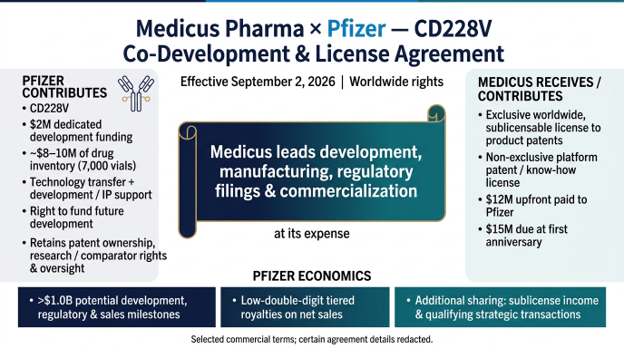
Medicus Pharma Ltd.'s (MDCX:NASDAQ) stock was pummeled after announcing its in-licensing agreement with Pfizer Inc. (PFE:NYSE) for the worldwide rights to CD228V, an early clinical-stage antibody-drug conjugate (ADC). On the surface, this reaction seems warranted because they have limited capital and put a good chunk of their war chest into a US$12 million upfront payment and have another US$15 million due in a year. Add to this milestone payments that could exceed US$1 billion, and investors are immediately thinking one thing — dilution.
It's blatantly obvious, but what if there was more to the story?
Imagine the story of a small-cap CEO waking up one day and telling his team we have no money, but we are going to land a potential multi-billion-dollar platform technology from a big pharma in the next 6 months. Sounds like a fairy tale, doesn't it?
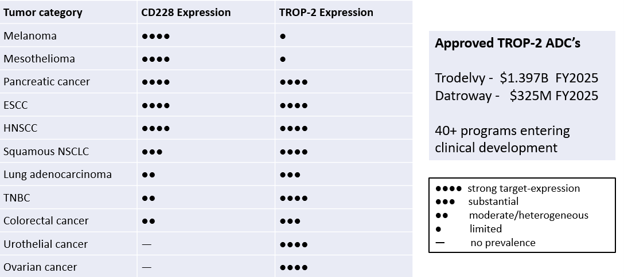
Investors really missed the strategic genius of the plan, which changes the complexion of MDCX from an early-stage dermatology and endocrine asset into an oncology platform technology. Under this plan, they greatly expanded the pipeline, reduced the potential for dilution, and enhanced the possibility of out-licensing. It now has a lead oncology program directed at CD228, or melanotransferrin, a target with high expression in a number of solid tumors and in a less competitive market than established ADC targets such as HER2 and TROP-2.
The Development Package is Worth More Than the Payment
As investors scrambled to sell, they completely overlooked the co-development package with PFE, which was actually cash neutral when looked at in the proper light. The cost was US$12.0 million, but they also got US$2.0 million in development costs, which resulted in a net outflow of US$10.0 million.
Roth analyst Jonathan Aschoff figured out that PFE promised MDCX US$8-10 million worth of the drug, which comes out to 7,000 vials, in addition to the intellectual property support and a shovel-ready clinical trial with 11 patients dosed to date. It's a neutral outflow. The hidden gem is in the sublicensing clause and the development plan, where PFE has an option to "fund ALL or part of the development." MDCX can leverage its rights to other indications beyond melanoma in order to quickly build out the platform technology through an out-licensing program.
Did Pfizer Really Throw Away an ADC?
The bear thesis is that PFE rejected CD228V and MDCX picked up a scrapped Pfizer asset destined for failure.
There is a kernel of truth to this thesis because Pfizer halted its Phase 1 development for a reprioritization of strategic capital after its acquisition of Seagen. In March 2026, for all intents and purposes, they mothballed the CD228V program for an impairment charge. They did, however, make it clear that they didn't have the bandwidth to manage another oncology platform technology and that their reasons for scrapping it were not due to safety or efficacy concerns.
Pfizer acquired Seagen for approximately US$43 billion in December 2023, gaining a major oncology and ADC franchise that includes Padcev, Adcetris, Tivdak, and Tukysa. Integrating an acquisition of that scale requires hard portfolio decisions. Big pharma is not in the habit of developing every drug that comes across its desk. It allocates capital behind the programs with the clearest strategic fit, the largest ROI, or the easiest to manage.
Pfizer got a black eye from the Seagen acquisition. In 2024 and 2025, PFE generated approximately US$6.0 billion in revenue from Seagen's oncology drugs and started culling a number of the drug candidates, which resulted in a US$4.4 billion impairment charge. While CD228V was part of the strategic fallout, it appears to be the sole survivor and PFE's best chance for vindication after their latest ADC sigvotatug vedotin failed its lung cancer trial. This is the part of the story that many investors are missing. Of the billions spent in development of Seagen's ADC platform, this is the last of the early-stage ADCs still standing, and its prospects are quite bright.
MDCX is precisely in this position because a small, focused company is more efficient in evaluating the strategic importance of an asset compared to the bureaucratic ecosystem of Pfizer.
CD228 Remains Viable
CD228 is a well-defined target in cancer that appears to be more broadly expressed on a number of solid tumor types. PFE's research has shown that tumor expression is 76% in melanoma, 64% in squamous Non-Small Cell Lung Cancer (NSCLC), 86% in Head and Neck Squamous Cell Carcinoma (HNSCC), and 94% in esophageal cancer. Chinese developers have also pursued the target. Boan Biotech (6955:HK) is developing an ADC targeting CD228 for the treatment of solid tumors in a number of different cancers. Boan completed its 30-patient Phase 1a study using BA1302 in August and expects to begin its Phase 1b trial in China "soon," which could mean the October to November time frame.
Coincidentally, last year, Boan presented their ADC BA1301 at the European Society for Medical Oncology (ESMO 2025) and announced the poster after the fact. While there can be no assurances, they will formally present BA1201 (CD228) Phase 1a data at ESMO 2026 from 23 – 27 October in Madrid; it's a possibility that investors should keep on their radar. The phase 1a teaser data Boan released indicated BA1032 had achieved partial response in a number of patients in a wide variety of cancer types who had failed 2 prior therapies, foreshadowing anti-tumor activity and a favorable safety profile.
ADC Market Showing No Signs of Cooling
According to Grand View Research, the antibody-drug conjugate market is valued at US$14.5B worldwide, but this includes blood and solid tumor cancers. The nearest comparison for CD228 is the TROP-2 ADCs valued at US$3.36B in 2025.
Given the existing revenues, the valuations are extremely conservative. TROP-2 ADCs represent a very close comparator to CD228V. It's also important to highlight that Boan Biotech carries a market cap of US$210 million (9/17/26) and trades on the Hong Kong Exchange (6955:HK).
The big pharma valuation of an ADC platform exploded in 2020 with Gilead Sciences' (GILD:NASDAQ) purchase of Immunomedics, the manufacturer of Trodelvy for US$21.0B. While that was the highest valued deal to date, recent acquisitions by Novartis (NVS:NYSE) in July 2026 of privately held Myricx Bio for up to US$1.5B for its preclinical-stage platform demonstrate there is strong demand for ADCs.
Biotech investors not taking advantage of the low MDCX valuation are overlooking GILD's April 2026 acquisition of Tubulis for US$3.1B upfront and up to US$5.0B including milestones, which has two Phase 1b/2 ADC assets undergoing clinical trial development.
Across the board, these billion-dollar valuations are in stark contrast to the US$10 million net price tag that MDCX paid for CD228V.
Why MDCX Was Positioned to Complete the Transaction
The most interesting part of the Pfizer transaction may be less about the asset and more about how MDCX positioned itself to pursue and ultimately complete a transaction involving a clinical-stage oncology program of this scale.
MDCX Chief Executive Officer Dr. Raza Bokhari has experience in public-company financing, asset aggregation, and early-stage clinical development. Before Medicus, he was chairman and CEO of FSD Pharma, where he helped oversee its pivot from medicinal cannabis toward clinical-stage biopharma development. FSD Pharma is now known as Quantum Biopharma (QNTM:NASDAQ). During his tenure, he raised US$100 million from institutional investors, which set the stage for a number of acquisitions after his departure.
This background helps explain how MDCX had positioned itself to pursue a significant clinical-stage oncology transaction. The company had assembled an executive team familiar with public-market financing, a stated strategy of advancing programs through clinical proof of concept, and a board and medical team built to support clinical development and dealmaking. Dr. Bokhari's experience in public-company financing, clinical development, and strategic transactions informed Medicus's preparation for pursuing and ultimately completing the CD228V transaction. Bokhari has said that gaining access to an attractive opportunity is only the beginning; once in the room, a small biotechnology company needs the right team, capabilities, financial resources, and a development plan to be taken seriously.
Genesis of a Plan
The chief medical officer, Dr. Faisal Mehmud, also had prior Pfizer experience as Global Medical Franchise Head for Precision Medicine & Early Oncology Development during Pfizer's Seagen acquisition. That background may have provided operational familiarity with the oncology environment and the expectations around assessing a Seagen-originated ADC program.
According to an interview with Bokhari on September 8, 2026, Medicus management believed that pursuing a transaction of this magnitude required credible clinical-development capabilities, an experienced board, sufficient capital, and credible access to additional capital. Those were management's own priorities in preparing MDCX to pursue and responsibly advance a significant clinical-stage asset.
Bokhari's view was straightforward: access to an opportunity is only the first step; Medicus also needed the organizational, clinical, and financial capacity to execute if an opportunity materialized.
Small-cap investors often see a licensing deal and focus primarily on price. In biopharma, especially for a program that may require years of work and substantial capital, development credibility, financing capacity, and breadth of experience can matter just as much to the ability to execute a transaction and advance the resulting program.
The Financing Setup That Put MDCX in Position
Pfizer terminated Phase 1 development of CD228V in March 2026 as part of a broader portfolio reprioritization. That created an opening for Medicus Pharma, but an opening is not the same thing as winning a licensing process. Pfizer needed more than a buyer for a clinical-stage ADC. It needed a counterparty capable of funding development, operating the program, and expanding the asset beyond its initial melanoma opportunity.
Bokhari said management concluded that Medicus needed, in addition to its clinical-development team and board-level experience, sufficient cash on hand and credible access to additional capital.
Management moved to close that gap through a SEPA and ATM drawdown and a secured promissory note, enabling MDCX to publicly cite approximately US$30 million in available cash. The company then strengthened its financing flexibility. On April 23, 2026, MDCX announced a US$50 million at-the-market, or ATM, program expansion, which, among other things, very likely signaled to Pfizer an additional capital-access mechanism.
MDCX is extremely undervalued and trades at approximately a US$10 million market cap.
That financing flexibility was particularly important because smaller public companies can be constrained by the SEC's "baby shelf" rule.
In general, companies with a public float below US$75 million may use a Form S-3 shelf registration statement (General Instruction I.B.6) to sell no more than one-third of their public float during any rolling 12-month period. Medicus management believed that completing a transaction was only part of the challenge; the company also needed sufficient financial flexibility to continue advancing a capital-intensive oncology program following closing. MDCX's financing arrangements and ATM capacity were intended to help provide that flexibility.
On September 14, through an 8-K filing, MDCX disclosed that it had terminated the SEPA with Yorkville Securities. Pursuant to the SEPA, MDCX had the right to issue and sell to Yorkville up to US$15.0 million of its common shares.
That changes the way investors should view the Pfizer transaction. MDCX did what it needed to do to complete the Pfizer transaction and is now taking steps to minimize dilution.
What Investors May Be Underpricing
CD228V targets melanotransferrin/CD228 using a humanized IgG1 antibody, a protease-cleavable linker, and a monomethyl auristatin E (MMAE) payload. The thesis is not simply ownership of an ADC; it is execution — focused indication selection, biomarker-led development, and disciplined clinical spending. Melanoma is the first test, with successful proof-of-concept potentially opening other CD228-expressing solid tumors.
MDCX has disclosed that it has exclusive worldwide, sublicensable rights, while retaining sole authority over development, manufacturing, regulatory approval, and commercialization. That sublicensing feature is particularly important. If management produces credible clinical evidence, Medicus does not necessarily need to commercialize CD228V independently. It could seek regional licensing, co-development, or broader strategic transactions—while Pfizer participates economically under the original agreement.
The agreement also provides Pfizer a right, but not an obligation, to elect to fund all or part of the development from and after the first pivotal trial. Any such arrangement would require a separate definitive agreement, and Pfizer is not committed to funding it today. Investors should not treat this as a guaranteed Pfizer partnership. They should, however, recognize that MDCX now has an established contractual relationship with Pfizer, a company that retains economic exposure and specified involvement in the program.
The Near-Term CD228V Catalyst
MDCX's September 8 update says the company is prioritizing CD228V in melanoma as part of a broader repositioning toward precision oncology. It also says Medicus will pursue capital-efficient partnerships for SkinJect and Teverelix. This creates a cleaner strategic narrative: CD228V becomes the central oncology platform, while other assets can potentially be advanced through partnerships rather than entirely through Medicus's balance sheet.
Boan Biotech's CD228-related clinical readout may be an important near-term event for investors following the program. Positive data would validate the target, revive attention around the asset, and improve MDCX's leverage in discussions with prospective partners. Conversely, weak or ambiguous data would be a major risk, underscoring why the stock should be viewed as a high-risk clinical-development opportunity rather than a straightforward value investment.
SkinJect Could Create Licensing Optionality
The CD228V transaction should not obscure the value of MDCX's existing pipeline. SkinJect, the company's doxorubicin-containing microneedle-array program, has already generated Phase 2 data in nodular basal cell carcinoma. Medicus has subsequently moved the program into an NDA-enabling registrational study in Gorlin syndrome after receiving an FDA "Study May Proceed" notice.
MDCX's current strategy appears to be increasingly selective. Rather than attempting to self-fund every indication, the company has announced that it will pursue capital-efficient partnerships for SkinJect and Teverelix. That makes sense. SkinJect is potentially attractive to dermatology-focused commercial partners, while MDCX can preserve capital and managerial attention for CD228V.
A prospective SkinJect licensing transaction should not be modeled as certain. But it is an underappreciated form of optionality. A partner could provide upfront capital, development support, milestone payments, and downstream royalties. In that scenario, SkinJect would become more than a pipeline asset—it could help fund MDCX's oncology priorities while reducing the need to finance every program through equity issuance.
The market's narrow focus on the Pfizer payment obligations may therefore be missing an offsetting possibility: MDCX has multiple assets that may be better monetized through external partners than through wholly internal development.
Teverelix Adds Additional Shots on Goal
Teverelix, acquired through MDCX's Antev platform, is another source of potential value and risk. Medicus has reported FDA feedback and Central IRB approval for an optimized Phase 2 study in acute urinary retention relapse, with expected enrollment of approximately 126 patients compared with roughly 390 patients under the previously disclosed plan. If executed as described, that smaller study design could be meaningfully more capital-efficient than the earlier plan.
The company is also advancing a genomics-guided Phase 2a study of Teverelix in women with endometriosis, authorized by the UAE Department of Health. These indications extend the potential commercial relevance of Teverelix beyond prostate-related disease, though each will require capital, clinical execution, and ultimately supportive data.
Investors should distinguish between pipeline breadth and funded development. A company can possess several attractive therapeutic opportunities while still lacking the resources to develop all of them simultaneously. MDCX's stated emphasis on partnerships is therefore not merely a strategic preference; it is central to the investment case. The company must show that it can prioritize capital, avoid excessive dilution, and create transaction value from non-core or partner-ready programs.
A More Disciplined Burn Profile
The September 8 announcement suggests Medicus is moving toward a more focused precision-oncology strategy while seeking partners for SkinJect and Teverelix. That strategic prioritization could matter as much as the Pfizer transaction itself.
Small biotechnology companies often lose investor confidence by maintaining too many clinical programs, each requiring separate trials, manufacturing work, regulatory engagement, and infrastructure. MDCX's opportunity is to prove it can do the opposite: concentrate internal spending where it sees the strongest risk-adjusted return while using licenses, collaborations, and regional partners to advance the rest of the pipeline.
This approach does not guarantee lower cash burn. CD228V is an oncology asset, and oncology development is expensive. But the goal should be clear: spend enough to create the next material value inflection, then use stronger data to negotiate better financing or partnership terms.
Insider Transactions Need Careful Interpretation
MDCX investors may have recently seen a number of Form 4 filings and think that management is bulking up on cheap stock. While the stock is cheap, it is not free; each of these insider awards is accompanied by a tax bill.
It's not uncommon for stock awards to have immediate tax withholding even though they are constrained from an immediate sale. These awards tie management's compensation to the share price and are consistent with a belief in the company's future, though, unlike open-market purchases, they are grants rather than capital put at risk.
The Bigger Idea: Capital Allocation as Drug-Development Innovation
The CD228V transaction can also be viewed through a broader strategic lens. Rather than building drugs from scratch, Medicus is looking to take promising drugs that already carry substantial sunk investment and place them into an optimized clinical development plan.
Through this process, the company is able to evaluate the optimal development pathway that takes into account the most valuable or defined patient group (biomarkers), the least development risk, and strategic fit with its existing or future partners.
The end goal is the monetization of the drug through licensing and partnerships, and then reinvesting when the results are proven.
In shorthand, the model is: Identify → Acquire or License → Re-underwrite → Focus → De-risk → Partner or Monetize → Reinvest.
The primary objective is not pipeline growth, but capital allocation toward the opportunities offering the most compelling risk-adjusted return, while using partnerships, external financing, and alternative ownership structures for programs that may create more shareholder value outside the company's principal internal capital priority.
There is a useful historical analogue in Roivant Sciences' (ROIV:NASDAQ) asset-focused model: large pharmaceutical companies routinely deprioritize programs for strategic, portfolio, or capital reasons that are not necessarily the same as scientific failure. A smaller, focused operator can sometimes create value by selecting the right asset and executing against a narrower development thesis. Medicus's version is distinct: in CD228V, Pfizer retains economic exposure and specified involvement, while Medicus has worldwide sublicensable rights and operational responsibility. That alignment makes the transaction more than a simple purchase of a discarded asset.
The Bottom Line
MDCX is extremely undervalued and trades at approximately a US$10 million market cap. It had US$25 million in cash at the end of Q2, less the US$10 million net cost of the Pfizer license, leaving approximately US$15 million of net cash, which corresponds to the $15 million anniversary payment due to PFE in 12 months.
The sublicensing rights are particularly compelling in a hot ADC market, where clinical-stage programs with credible target validation can attract major strategic interest. MDCX does not need to finance every CD228 indication internally. With worldwide rights, they have extreme flexibility to talk to anyone interested in an ADC and can license them for whatever the market can bear. With Gilead's multibillion-dollar deal announced in the spring, it's not hard to envision that a conservative valuation of the ADC asset is capable of bringing in hundreds of millions upfront, assuming Boan Biotech has a positive readout. The market is assigning no value to this licensing potential.
SkinJect is perhaps a more immediate source of an upside catalyst. The program has Phase 2 data, identified a lead 200 µg dose, and is being developed for Gorlin syndrome. This pivot, along with the pending Rare Pediatric Disease Designation request, has meaningfully de-risked the asset. MDCX has been looking for a partner for over a year and now has a clean, shovel-ready partnering opportunity. A Rare Pediatric Disease Designation that converts into a Priority Review Voucher (PRV) upon approval could be worth US$200+ million.
In June, Denali Therapeutics (DNLI:NASDAQ) sold its rare pediatric disease voucher for US$195 million following the approval of Avlayah, which means a licensing partnership or sale of the asset would be a discount to the price and might still give them the optionality to pursue label expansion after it is approved. A partnership announcement would be a stunning catalyst and cause for an immediate rerating of the company, as a significant transaction would enable funding of their leading drug candidate, CD228V, and allay the market's obsession over dilution. There are a lot of risks in MDCX — financing, regulatory, execution, and — with the stock near US$0.16 — Nasdaq minimum bid price compliance.
The valuation is pricing in a highly pessimistic outcome while offering multiple potential avenues for a sharp re-rating event. MDCX is an investment for biotech investors who believe the PFE license has transformed the company into a more capable, better-connected, precision-oncology-focused biotechnology company.
The more durable question is whether MDCX can make this model repeatable. If it can identify overlooked pharmaceutical value, structure access efficiently, determine where incremental investment can generate the greatest return, and then convert clinical progress into partnerships or monetization, the company's long-term asset becomes more than any single molecule. It becomes an operating capability for capital-efficient drug development.
That is the strategic concept the market may be missing. CD228V is the first major test of whether capital allocation itself can become a source of innovation: not necessarily inventing every molecule internally, but executing efficiently on assets whose prior owners have already funded much of the scientific and development foundation.
| Want to be the first to know about interesting Biotechnology / Pharmaceuticals investment ideas? Sign up to receive the FREE Streetwise Reports' newsletter. | Subscribe |
Important Disclosures:
- Mike Sheikh: I, or members of my immediate household or family, own securities of: Medicus Pharma Ltd. My company has a financial relationship with: None. My company has purchased stocks mentioned in this article for my management clients: None. I determined which companies would be included in this article based on my research and understanding of the sector.
- Statements and opinions expressed are the opinions of the author and not of Streetwise Reports, Street Smart, or their officers. The author is wholly responsible for the accuracy of the statements. Streetwise Reports was not paid by the author to publish or syndicate this article. Streetwise Reports requires contributing authors to disclose any shareholdings in, or economic relationships with, companies that they write about. Any disclosures from the author can be found below. Streetwise Reports relies upon the authors to accurately provide this information and Streetwise Reports has no means of verifying its accuracy.
- This article does not constitute investment advice and is not a solicitation for any investment. Streetwise Reports does not render general or specific investment advice and the information on Streetwise Reports should not be considered a recommendation to buy or sell any security. Each reader is encouraged to consult with his or her personal financial adviser and perform their own comprehensive investment research. By opening this page, each reader accepts and agrees to Streetwise Reports' terms of use and full legal disclaimer. Streetwise Reports does not endorse or recommend the business, products, services or securities of any company.
For additional disclosures, please click here.